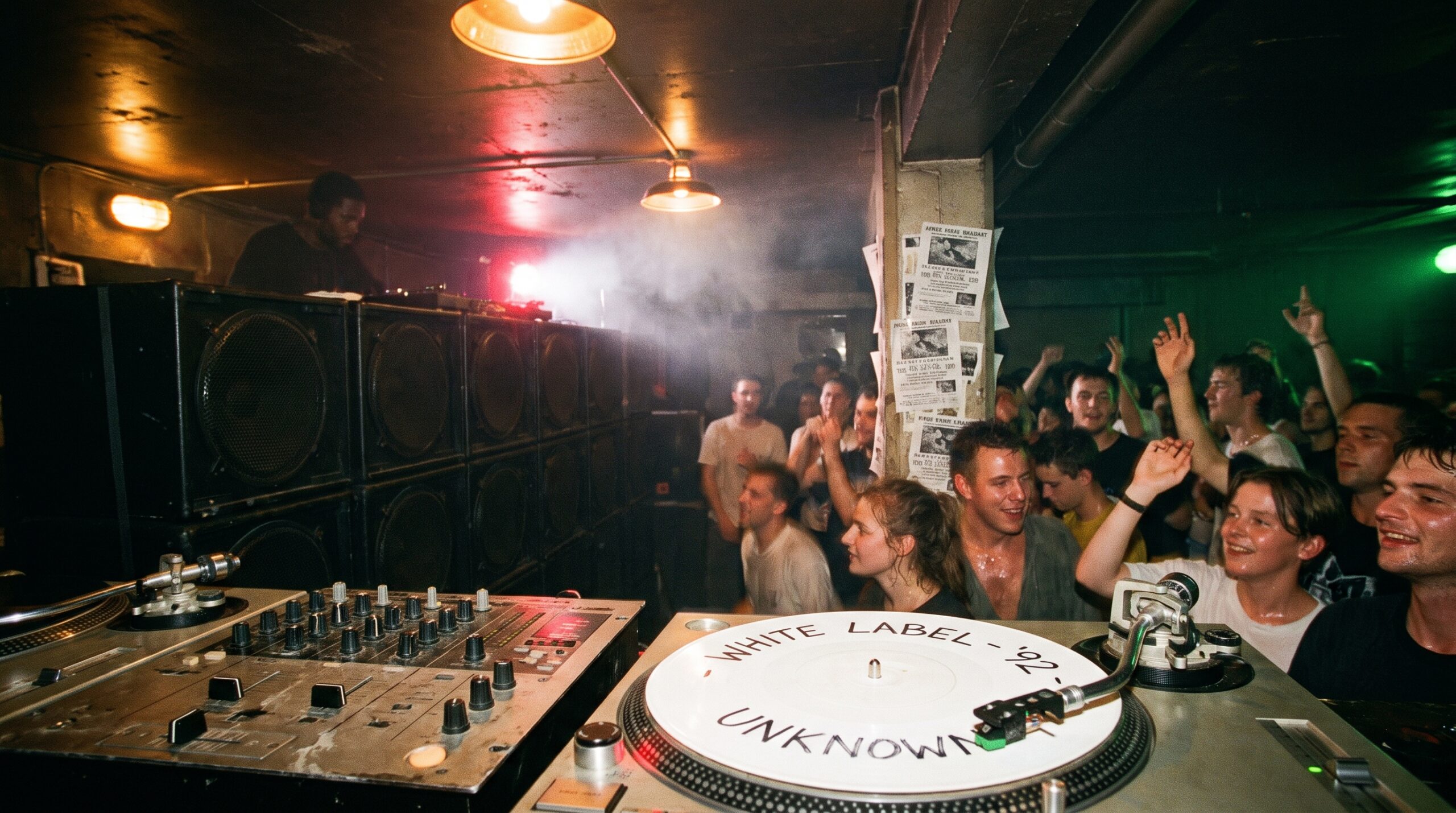

If you can imagine standing in a room where the floor is moving before the tune has even dropped, where the bassline seems to come up through the soles of your shoes and out through the top of your head, where the DJ is not playing records so much as having a conversation with the crowd in real time — that, in a manner of speaking, is what Jungle felt like the first time it found its own voice.
It is hard to put an exact date on the moment Jungle became Jungle. The honest answer is that nobody sat down one afternoon in a studio in Hackney or Bow or Bow Triangle and decided to invent a new genre — what happened was messier, slower, and more interesting than that. A handful of producers in the early 1990s started pulling rave and breakbeat hardcore in a particular direction, and the rest of us, listening through pirate-radio speakers and clapped-out soundsystems in warehouses and back rooms, started to recognise what they were doing as a different kind of music entirely. By the time most people outside the scene had noticed it existed, it was already a thing with its own language, its own crowd, its own physics. This is an attempt to describe how that happened — without pretending any of us had the full picture at the time.
Before Jungle, there was rave
You have to understand where UK dance music was in 1991 to understand what came next. The rave scene was in full swing — Second Summer of Love, all that — and the sound was breakbeat hardcore, which itself had been pulled out of Belgian new beat and Italian piano-house and American house and welded together into something that could lift a warehouse full of people off the floor at four in the morning. The tempos were quick, the breakbeats were the same Amen / Think / Funky Drummer patterns that had been doing the rounds in hip-hop for years, the tracks were euphoric and the energy was simply enormous.
If you were there, you remember the records: the SL2 records, the Manix records, the early Suburban Base and Reinforced and Moving Shadow output. They were brilliant. They were also, for a particular kind of listener, the start of a question — what if we pushed this further? What if the breaks went harder, the bass got deeper, the reggae samples came more to the front, the room got darker? You would hear a hardcore record and think, this is massive, but I want it darker. You would hear a ragga-jungle tune by Sweetie Irie or the General Levy records and think, that MC element is the future. You would hear a track on a sound system at AWOL or One Love or a basement in Stoke Newington and think, the system is making this do something I have never heard before.
That was the mood going into 1992, 1993, 1994. Not a manifesto — just a slow gravitational pull.
The sound changed under its own weight
What you started hearing on the more interesting records of that period was a handful of things happening at once. The breakbeats, where they used to sit at the back of the mix, came forward and got faster, choppier, and a lot more muscular — not just sampled but sliced into individual hits, the kick separated from the snare separated from the hat, then rebuilt at the sampler’s whim, sometimes timestretched, sometimes pitched up, sometimes dragged in half-time and re-laid over a faster pattern. The Amen Break, that six seconds of the Winstons’ “Amen, Brother” from 1969, became the central character in the story. Producers like A Guy Called Gerald, DJ Randall, Doc Scott, The Sentinel, and a small handful of others were making records where the Amen was not a loop but a vocabulary.
And underneath the breaks, the basslines changed. The hoover stabs of hardcore got heavier, lower, more sustained; the Reese bass that Detroit and Chicago producers had been perfecting for years got pulled in and tuned down to where it sat in your chest rather than on top of the mix. Sub-bass that you could feel three streets away from a sound system became a non-negotiable part of the records. Drums got hit harder, the swing in the programming got looser, the rimshots snapped. The 909 clap became a near-obligatory punctuation. The whole mix sounded heavier, lower, more physically present in a room.
Then there were the vocals. Hardcore had been mostly sample-based, all hands-up and piano stabs. Jungle started to lean on reggae and dancehall vocal samples in a way that hardcore had not, in a manner of speaking, dared to. Bobby Digital records, Buju Banton, Junior Reid, Bounty Killer — the ragga end of reggae lent the music a lyrical directness that the rave crowd had not heard on a dancefloor before. “Bam Bam” by Sister Nancy became a foundational sample. “Play It Loud” by Shinehead got cut up. The dancehall MC tradition started to feel native to the music, not borrowed.
You can hear all of this in records that came out on Reinforced, on Suburban Base, on Moving Shadow, on Labello Blanco, in the 1992-1993 window. They were not labelled Jungle yet, because the press and the shops and even some of the producers were still catching up. They were just very, very obviously a new thing.
The sound system is the other half of the story
It is genuinely impossible to talk about how Jungle found its own voice without talking about sound systems, and sound systems means talking about Caribbean and West Indian community culture. The custom-built speaker stacks that defined UK dance music from the late eighties onwards were not invented by the dance music scene — they came out of reggae, dub, and sound system culture that had been here since the seventies. The way a soundsystem plays a record is a particular craft: the way the kick, the bass guitar, the snare, the vocal and the high hats are all given their own lane in the stack and pushed to a level where each one is its own physical event. It is the same craft that Jamaican sound systems brought to Notting Hill Carnival and to the blues dances of the 70s and 80s, and which Black British sound systems carried forward into the warehouse scene.
What that meant in practice is that Jungle was, in its physical reality, a sound system music before it was a record music. The records were made to be played on a wall of custom speakers in a room full of people. Producers were making records and then taking them out and testing them on systems — their own, their friends’, the rig at a club night, the rig someone had set up in their living room. The records that worked on a system got played again. The records that didn’t quietly disappeared. It was, and still is, the most honest form of A&R in the world.
The moment it became recognisably Jungle
There is no first Jungle record in the way that there is a first punk record or a first garage record. There is a moment in 1993 and into 1994 where the music started to sound like itself in a way that anyone who had been paying attention could not deny. Producers were confidently chopping Amen breaks, ragga vocals, deep sub-bass and orchestral stabs into records that were designed to do damage on a system. The tempo settled into that classic Jungle range. Theatrical arrangements and hoover stabs gave way to tighter, more percussive tracks. The pirate radio stations — Kool, Flex, Rude, Raw, Rinse — were playing the new records heavily, and the records were travelling the country through tape dubs and white labels and shout-outs.
By the time Goldie’s Timeless came out in 1995, the genre was already a thing, and Timeless is as good a statement of arrival as any genre has ever produced. But there were years of records that came before it, and a great many records that came after, where the sound kept being refined and pushed. There is no clean starting line. There are producers, working in studios in unfashionable parts of London, who started making records that were recognisably Jungle before any of them would have called it that.
Why it still sounds alive
What made Jungle land in 1993, and what makes it still land when a new record comes out on a label like V Recordings or Hospital or one of the many small digital labels doing the work today, is the same thing. It is the combination of the rhythm, the bass, the breaks, the system, the crowd, and the records’ sense that they are written to be played loudly in a specific kind of room. It is a music that does not work quietly and does not pretend to. The breaks chop and roll in a way that is impossible to fake. The bass sits at a frequency you feel. The MC and vocal tradition gives the records a verbal and lyrical register that ties them to the Caribbean and Black British culture that produced the sound. None of that has gone away.
If you are new to the music, the easiest way in is to find a good system and a good DJ and let the records do the explaining. There are still nights where that happens. There are also a great many records from the early 90s that are still getting reissued, re-appreciated, and remixed by people who were not born when they came out. Jungle never stopped finding new listeners. It just got quieter about it for a while.
And if you are someone who was there, you already know all of this, in a manner of speaking. You might argue with my dates. You might have a different memory of the moment it tipped over. That is exactly the right response. Jungle has always been a thing people disagree about, in clubs, in record shops, in pirate radio shout-outs, in tune ID requests, in the corner of a flyer. The argument is part of the music.
Leave a Reply