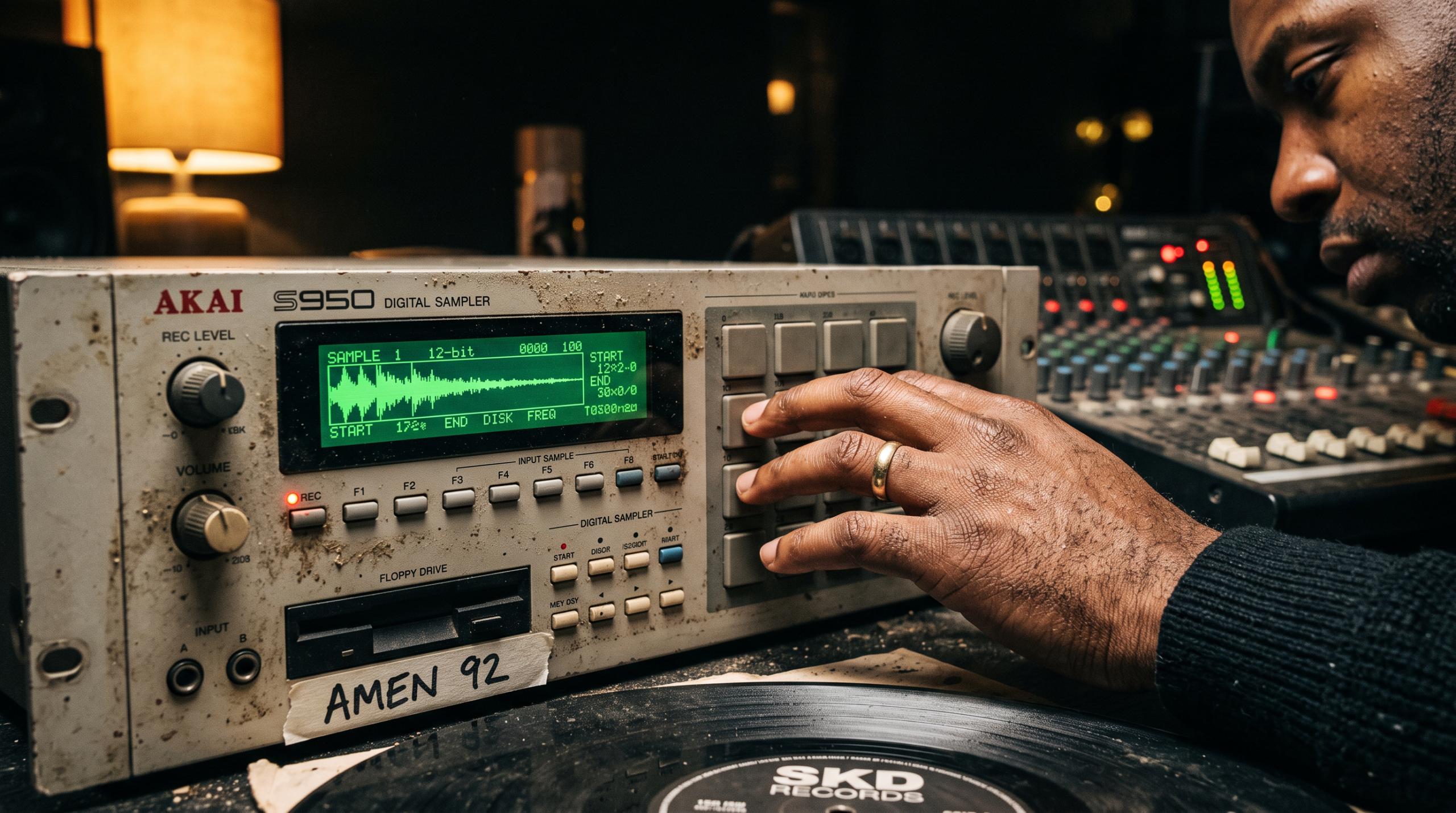

Six seconds of drums. That is all it is, give or take. Six seconds from a B-side of a 1969 soul record, played by a drummer whose name most people never knew, in a song nobody thought was going to matter. Then sampled, chopped, pitched, stretched, reversed, layered and re-performed by twenty years of producers — and ended up, in a manner of speaking, as the rhythmic spine of an entire genre.
The Amen Break is, by some distance, the most sampled loop in popular music. It is also the thing that makes Jungle sound like Jungle. The two facts are not unrelated. The break is short, it is loud in the mid-range, it is human, it is swung in a way that a sequencer cannot quite replicate, and it has a snare that hits where you expect it to. Every Jungle producer in the world has at some point sat in front of it and decided what they wanted to do with it, and the answers to that question are what the genre actually sounds like.
Where the break actually came from
The record is “Amen, Brother” by The Winstons, a soul and funk group out of Washington, D.C. It was released in 1969 as the B-side to “Color Him Father,” which won the Grammy that year for Best Rhythm and Blues Recording. The drummer on the session was Gregory Coleman. The break is the four-bar drum passage that comes in about a minute and a half into the track — a syncopated, swung pattern with a strong kick on the downbeat, a tight snare on the three, an open hi-hat that breathes, and a few ghost notes on the snare that give it a human push. The Winstons did not know, the label did not know, and Mr Coleman, sadly, did not benefit from it in his lifetime. He died in 2006 and a crowdfunding campaign was set up a few years later in his name.
The break started being lifted into hip-hop in the second half of the 1980s. N.W.A.’s “Straight Outta Compton” used it. So did tracks by the Bomb the Bass, by Smith & Son, by the scattered producers who were making the records that fed into what became the rave. The first time most British dance music producers heard the Amen, it was probably in a hip-hop record, on a pirate-radio mixtape, or in a sound system set. The break was already travelling before Jungle made it central.
What the sampler did to it
What changed in the late eighties and early nineties was that the samplers got cheap enough and good enough for producers to work with on a desktop. The Akai S900 and then the S950, the Roland S-50, the S-760 — these were the machines that made it possible to take a break, chop it into individual hits, lay the hits out on a grid, pitch them up and down, timestretch them, and rebuild them into new patterns. A break that had been a loop was now a vocabulary. A snare hit became one sound, the kick another, the hat another, and each could go anywhere the producer wanted it to go.
This is the moment Jungle becomes possible. Before the sampler, a break was a thing you looped. After the sampler, a break was a thing you played. Producers started writing breaks rather than sampling them — programming their own drums to sound like sampled breaks, in a kind of feedback loop where the sampler taught the producers what to programme and the programming made the sampler records more ambitious. Akai eventually released an MPC60 that, in a manner of speaking, every serious Jungle producer owned by 1993, and the records that came out of MPC60-equipped studios sounded like nothing that had come before them in any genre.
What Jungle did with the Amen specifically
There is no single way Jungle treats the Amen. The break, in the right hands, can be made to do almost anything. A producer in 1993 with a 950 and a sampler full of reggae vocals could chop the Amen into individual hits, lay them across a deep Reese bassline, and bring a ragga vocal in over the top. A producer in 1994 could timestretch the Amen to half its original tempo and lay it under a slow, almost ambient pad. A producer in 1995 could pitch the Amen up, speed it up, and put it inside a rolling, frantic, almost drum-and-bass pattern that lost the original swing entirely. The break accommodated all of it.
The records people remember are the ones where the producer made the break do something specific. There are producers whose Amen programming is recognisable from a few bars in — the way the snare lands, the swing of the kick, the placement of the ghost notes, the way the hats breathe. Goldie’s “Inner City Life,” A Guy Called Gerald’s “FX,” DJ Randall’s “Let Me Tell You Something,” Doc Scott’s “Machines,” Peshay’s “Vocal Tune,” The Sentinel’s “Stroke of Luck,” and L Double’s early Flex Records material all came from the same wider language of chopped breaks and bass pressure, yet each had its own character. None of these records sound the same, and that is really the point: the break stopped being just a sample and became part of Jungle’s vocabulary… something producers could bend, rearrange and make unmistakably their own.
And that is also why the break gets used differently depending on what kind of record you are making. A ragga-jungle tune will lean on the snappy, syncopated end of the Amen. An atmospheric, deep-jungle tune might use a slowed, timestretched version of the break as a backbone and add a swung top loop. A rolling, dark-jungle record might chop it up so it is barely recognisable and rebuild the rhythm out of single hits. A hard-jungle record will hit the Amen with everything the sampler can do and see what survives. The break, in other words, is a starting point, not a recipe.
The other breaks, briefly
The Amen is not the only break in Jungle. The Think break (Lyn Collins, “Think,” 1972) is in there. The Funky Drummer (James Brown, Clyde Stubblefield, 1970) is in there. Impeach the President (The Honey Drippers, 1973) is in there, sometimes called the Impeach. Ashley’s Roachclip. Different Strokes by Syl Johnson. Hot Pants by James Brown. There is a whole library of breaks, and most producers keep their favourites. A good Jungle record is often a conversation between breaks as much as between sounds.
What the Amen has that the others don’t, or has more of, is the combination of a strong, recognisable mid-range thump and a swing that survives almost anything you do to it. Pitch it up, slow it down, chop it, layer it under a faster break — the swing comes back. There is something in the way Gregory Coleman played the kit that resists standardisation, and that is the thing that has kept producers coming back to it for thirty-plus years.
Why it still matters
Modern Jungle producers are still reworking the Amen. New records come out every month that take the break in directions the original producers could not have predicted, and the records that work best are usually the ones that are not trying to be retro — they are just using the break because it is still the right tool for the job. There is a thread that runs from Gregory Coleman in 1969 through to a 24-year-old producer in a bedroom in 2026, and the thread is six seconds of drums and what people have decided to do with them.
If you are starting to dig into the records, the Amen is the single most useful thing to learn. Train your ear to hear it in the mix. Listen to where it is, where it isn’t, and what is happening when it isn’t there. Once you can pick it out, you have a thread that runs through the whole genre, from the early Reinforced and Suburban Base records to the modern digital labels. Our sample database has a growing list of where the break has been used and what it became in the hands of different producers. Pull up a record, find the break, and listen to what was done with it. That is the entire history of Jungle in six seconds of drums.
Read next: How Jungle found its own sound. · Or: Pirate radio was Jungle’s social network.
Leave a Reply