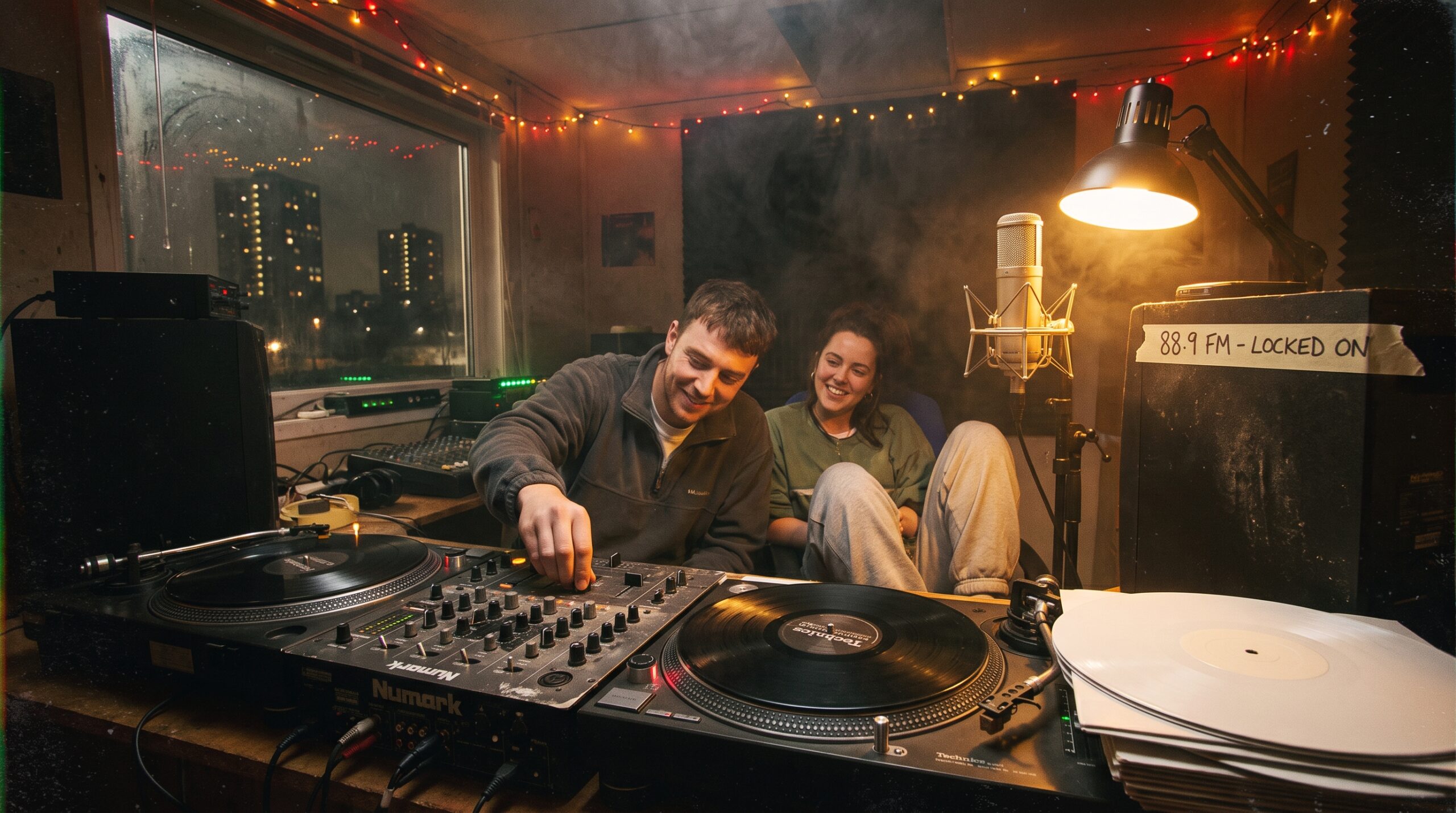

You are sitting in your room late at night, the volume low on whatever speaker you have got, the radio tuned somewhere up the FM dial, and you are sweeping through static. Then, between one hiss and the next, a beat appears. A snare. A sub. A vocal chop. You stop sweeping. You have just found a pirate radio station playing a Jungle record you have never heard before, and in a manner of speaking, that is how the entire scene used to work — somebody at the other end of a transmitter, somebody on this end of a cheap radio, and a record travelling between them through a wall of hiss.
It is hard to overstate how important pirate radio was to Jungle in the 1990s, and how much the equivalent ecosystem we have today — playlists, streaming algorithms, Bandcamp recommendations, Discord servers — is doing a fundamentally different job. The pirate-radio ecosystem was small, local, and human. It is the difference between asking a friend what they have been listening to and asking an algorithm. The music reached people because other people put it in front of them, in a way that did not scale and that depended on trust.
Before the algorithm, there were people
If you wanted to know what was happening in Jungle in 1993, the algorithm was a man called DJ Flight or a man called Randall or a man called a hundred other people who had transmitters on rooftops in Hackney, Peckham, Brixton, Tottenham, Stoke Newington, Handsworth, Moss Side, Toxteth, St Pauls. They had decks, a mixer, a mic, a stack of records, and a transmitter. They were not being paid for it. They were doing it because the music mattered to them, the records needed an audience, and the audience needed to know there was a new record.
You discovered new music through these stations the way you now discover new music through a friend’s link in a group chat. The station would play a record, you would ring in on the phone line (yes, a phone line — with a number you had memorised, or scribbled on the back of a flyer, or written on a piece of tape stuck to the wall next to the radio), and the DJ would either tell you what the record was or, more often, tell you to come down to the shop, or to the rave, or to a specific sound system, and find out. There were whole records that you only knew existed because a pirate-radio shout-out had mentioned them. The records were mysteries, the DJs were guides, and the system worked because everybody in it trusted everybody else.
MCs, shout-outs, and the community in the room
Jungle pirate radio had a particular format that does not really exist anywhere else. The DJ would play records, the MC — sometimes the same person, sometimes a friend with a mic — would ride the records, big up the station, big up the crowd, take phone-ins, request tunes, take requests. The MC tradition came out of reggae and dancehall, and it carried through Jungle in a way that no other UK dance music scene really replicated. You would hear a record, then a quick “big up Kool FM, big up the Mandem, all the rude boy selectas in the area, if you’ve got a tune for me, give us a call on the hotline,” and then the next record would come in. The whole thing felt like a conversation with the city.
The shout-outs were not just filler. They were the social network. A shout-out to a sound system would mean that system had a big event coming up. A shout-out to a record shop would mean a new white-label was in. A shout-out to a producer would mean they had a release out and you should go and find it. A shout-out to a pirate-radio station in a different part of London — or Manchester, or Bristol, or Glasgow — would mean there was a sister station, and you would tune in to them too. The shout-outs were, in a manner of speaking, the platform’s own recommendation engine, but they ran on reputation, not on metrics.
The phone-ins were a particular kind of magic. You would ring in and either request a tune you had heard elsewhere, or ask the DJ to ID a record you could not find, or just talk to the station for a minute. The DJs would ID records for you, sometimes on the spot, sometimes by pulling the label off a record, sometimes by saying “I can’t tell you on air, come down to the shop.” It was intimate, often chaotic, occasionally brilliant, and very often a record-store finder function in the form of a human being.
Dubplates and the cult of the exclusive
One of the things pirate radio made possible was the dubplate. A dubplate is a one-off acetate or test pressing of a record, often cut specifically for a particular DJ or sound system, with a label that says the date, the station, the system, or just the DJ’s name. A dubplate is the only copy in the world. It is the most exclusive version of any record you can have.
For a pirate-radio DJ, having a dubplate of a record that nobody else had was the most valuable thing in the world. It meant you could play the record on air, the crowd could hear it, and nobody could find it. The exclusivity of the dubplate, played in a context where the station had a real audience, gave the records a mythic quality. A tune that only existed on a dubplate on a pirate station, played by a particular DJ, heard by a particular crowd, became part of the story of Jungle. When the record finally came out properly, it carried the weight of the dubplate with it. Train-spotters — the people who obsessively ID records from pirate radio and the sound system — treated dubplates the way other music scenes treat unreleased demos. They were, in a manner of speaking, the holy relics of the scene.
Tape culture: how the records travelled
Pirate radio had a longer reach than the transmitter’s actual signal. People recorded the broadcasts onto cassette tapes, often in pretty rough conditions — a microphone held up to a kitchen radio, or a tape deck wired directly to a tuner. Those tapes were dubbed and re-dubbed and traded. A new record could be on a pirate station in Hackney on Friday night, on a tape in someone’s bag in Manchester by Sunday, on a tape in Glasgow by Wednesday. The transmission distance was maybe five miles, but the tape distance was the country.
The tapes were also how the scene documented itself. There are hours and hours of pirate-radio Jungle from the early to mid 1990s — Flex FM, Kool FM, Rude FM, Raw FM, Sub FM, Rinse FM before it went legal, a long list of stations, many of them shut down by the authorities and a surprising number of them coming back on a different frequency a few weeks later. Those tapes are the most direct record we have of what the scene sounded like at the time, and they are also, in their own way, part of the music. They are how a lot of people, including me, first heard Jungle records that were never properly released.
What we lost, and what survives
It is tempting to romanticise the pirate-radio era and pretend that what we have now is worse, but that is not really right. The ecosystem today — Bandcamp, Mixcloud, SoundCloud, the more human-curated corners of the streaming platforms, the label Discords, the SoundCloud groups — does some of what pirate radio did. It is global, it is searchable, it preserves the records, it lets you dig as deep as you want. There is more Jungle on the internet right now than there has ever been in any one place.
What we lost is the local, the small, the immediate. The sense that the record came from somebody in the next street who knew what they were doing. The trust that you built up with a station over months and years. The phone call, the shout-out, the dubplate exclusive, the tape in the bag. That intimacy does not scale.
What survives is the part that matters most — the fact that the records were made and the records were heard and the records mattered to the people who made them and the people who heard them. That is what JungleSound Radio is trying to do, in a different format, for a different moment. We cannot rebuild the pirate-radio ecosystem. We can keep the spirit of it, in a manner of speaking — the spirit being, somebody at one end of a transmission caring enough about the music to make sure somebody at the other end hears it properly. That is the part worth keeping.
Read next: How Jungle found its own sound. · Or: Why white labels still matter.
Leave a Reply