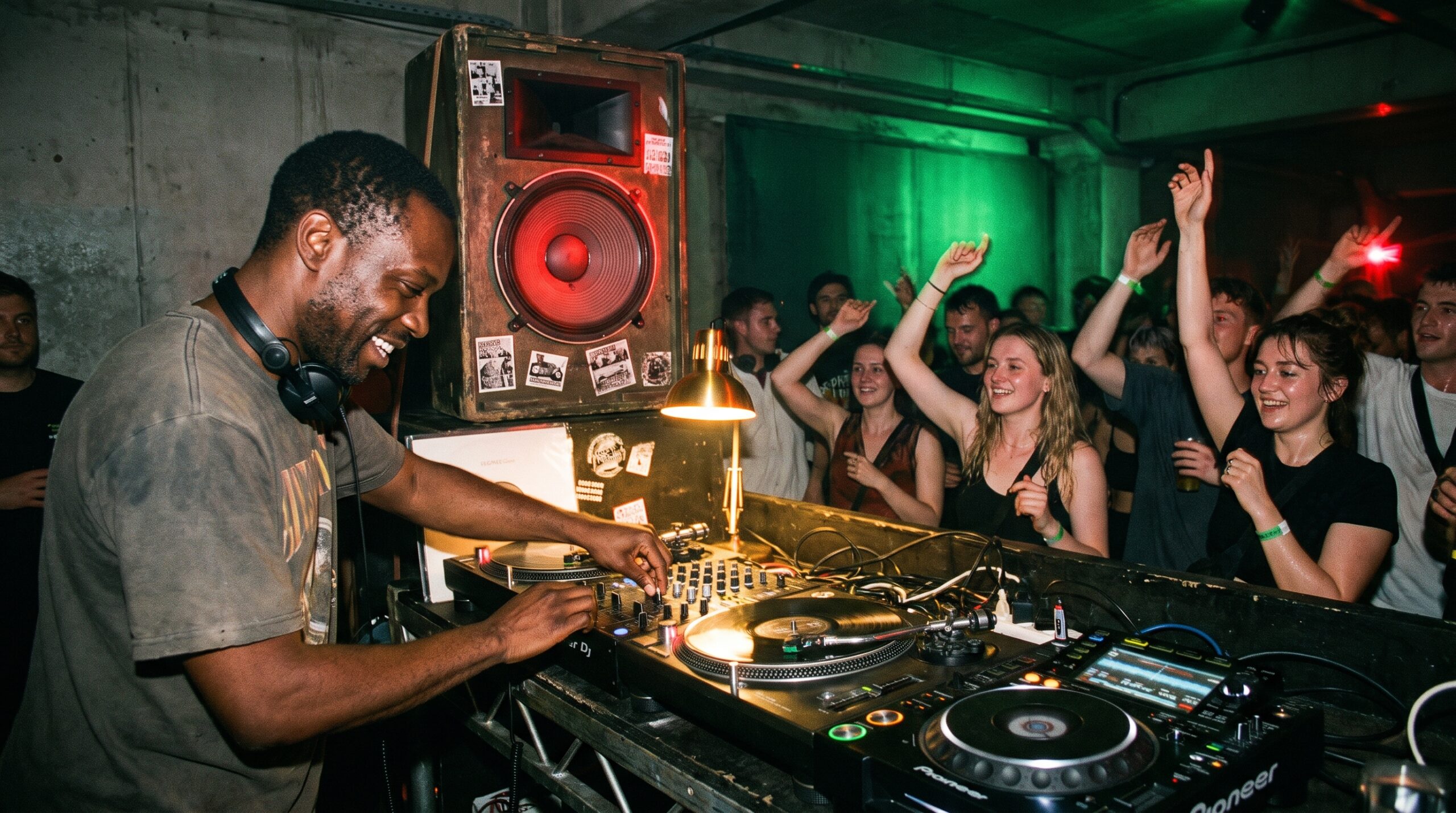

Every couple of years, somebody announces that Jungle is back. It usually goes like this: a record breaks through to a wider audience, a few publications run pieces, a festival puts a Jungle stage on, and a generation of listeners who have never heard the records suddenly find out that the genre exists. The headlines tend to be along the lines of “Jungle is back from the 90s” or “the genre that influenced everything is making a comeback.” Both of those are wrong, in a manner of speaking, and it is worth understanding why.
Jungle did not go anywhere. It changed, it moved, it went quieter, it picked up new producers and new audiences, it released records in different formats, it stopped being called Jungle for a while and then started being called Jungle again, and it is, in a manner of speaking, exactly the same age now as it has always been — somewhere in the middle thirties, still finding new things to do with the same six-second Amen break it started out with. The “revival” framing is wrong because it implies that the genre disappeared, and it did not. The producers kept producing. The records kept coming out. The nights kept happening. The crowd kept dancing.
The years when nobody was looking
What did change, in the late nineties and the early 2000s, was the press’s interest in the music. Drum and bass became the dominant UK dance music story, Jungle got folded into it as a subgenre, and the records being made by people who were clearly still doing Jungle — deeper, atmospheric, often on smaller labels — were no longer being talked about in the same way. The names changed. The tempo moved up a touch. The breaks were still the same breaks, but the records were less aggressive in the mix. A lot of the most interesting producers of the period — the LTJ Bukem / Good Looking axis, the early V Recordings material, the deeper end of the Moving Shadow catalogue — were doing music that you could not honestly call anything other than Jungle, even when nobody was calling it that.
What was happening at the underground level was not a disappearance. It was a continuation, with the music making less commercial noise and the audience for it moving into smaller rooms. Sound systems kept playing. Raves kept happening, in different venues under different names. The producers kept making records, and the records kept getting played on the sound systems. There was, in a manner of speaking, a whole world where Jungle continued to evolve, and most of the people who pay attention to Jungle know about it.
It is easy to forget, from the outside, that dance music scenes are small communities. They keep going regardless of whether the press is paying attention. The press catches up occasionally, declares that the genre is “back,” and then moves on. The community does not stop.
New tools, same obsession
The producers who have come up in the last ten or fifteen years are working with very different tools than the original generation. They have software samplers and DAWs on laptops, and they have access to every record that has ever been made, in a manner of speaking, on streaming services and YouTube. They do not need to physically dig through a record-shop crate to find a break; they can audition breaks from a hundred records in an afternoon.
What they have not lost is the obsession. The reason a producer spends a week timestretching an Amen break or layering a Reese bass underneath a chopped vocal is the same reason a producer did it in 1994: because that combination of sounds, on a system, in a room, is a specific kind of experience that is hard to get any other way. The tools have changed. The room has not.
There is also, in a manner of speaking, more of an audience now. A 19-year-old in Bristol or Manchester or London can find the entire history of Jungle in a weekend, if they go looking for it. The records are easier to hear than they were in 1994. The pirate-radio shout-outs are easier to dig out. The record shops are harder to find but the catalogue is more accessible. The people who would have been a small handful in 1993 are a global community now.
A new generation, finding the old records at the same time as the new ones
What is interesting about the present moment is that for the first time, in a manner of speaking, the new generation is discovering the 1993-1996 records alongside the records that are being released now. In 1996, if you were 16, you had to dig for the old records — they were not on streaming, they were not on YouTube, and the only people who had them were DJs and serious collectors. In 2026, a 16-year-old can hear the whole of the 1993-1996 Reinforced and Suburban Base and Moving Shadow catalogue in an afternoon, and then listen to what is being released this month, and notice that the producers in 2026 are still building on the same foundation the producers in 1993 were building on. They are not separate things. They are one continuous thing.
This is one of the things that makes the present moment feel particularly alive in Jungle. There is more of the music accessible to more people, from more periods, than at any point in the genre’s history. A new producer can study a 1994 record and a 2024 record in the same afternoon and start making records that pull from both. A new listener can do the same. The argument that has sometimes been made — that the genre’s history is “lost” — is, in a manner of speaking, less true now than at any point in the last thirty years.
Global Jungle, without losing the UK roots
One of the more interesting things about contemporary Jungle is how unapologetically global it has become. There are producers making Jungle records in Tokyo, in São Paulo, in Berlin, in Auckland, in Cape Town, in New York, in places where the UK rave history is something they have researched rather than lived through. The records are, in many cases, recognisably Jungle in the way that matters — the breaks, the bass, the system — and they bring their own musical traditions to it. The Brazilian producers bring the rhythms of baile funk and forró into the mix. The Japanese producers bring the precision and the particular low-end physics of Tokyo sound system culture. The UK producers keep doing what UK producers do.
This is a long way from the early 90s London scene, and the scene has, in a manner of speaking, always been a global one. The records travelled because tapes travelled. The dubplates travelled because DJs took them to other countries. The system worked because the people who cared about the music wanted to share it with people who had not heard it yet. The current global Jungle is the same thing, scaled up.
Why right now feels exciting
What feels particular about the present moment, beyond any individual record or night, is that there is more access to more of the music’s history, alongside more of the music being made now, than there has ever been. The labels that have been doing the work for thirty years — V Recordings, Hospital, Good Looking, Metalheadz, the smaller digital-only labels — are still releasing records. New labels are starting up. There are nights in most major cities that play Jungle regularly. The producers are cross-generational — a 25-year-old producer and a 55-year-old producer on the same bill, finding out they have more in common than they expected.
And the audience is broader, and more curious, than it has been in a long time. People are coming to the music from all sorts of directions — through the UK drill and grime scenes, through the European techno scenes, through hip-hop production, through the global dub and reggae traditions the music is rooted in, through the various bass-music scenes that have come and gone in the meantime. They are finding the records and finding out what they are, in a manner of speaking, and a lot of them are staying.
It does not need to be mainstream to matter
One of the things that is occasionally frustrating about the “Jungle is back” framing is the implicit suggestion that the genre is only really doing well when the wider press is paying attention. That is not, in a manner of speaking, how dance music works. The scene is small. It has always been small. The records matter to the people who make them and the people who play them and the people who dance to them, and that has been enough for thirty years. The fact that the music is in a healthier place now than it has been in a while, with a global audience, with new producers coming up, with more of the history accessible than ever, is genuinely good news. The fact that the wider culture is also paying more attention is, in a manner of speaking, a bonus. The scene does not depend on the press to be a scene.
If you are new to the music, the best thing to do is to start listening. Start with the records that made you curious. Follow the trail backwards. There is a great deal of music waiting for you, in a manner of speaking, and the people who made it are still around and still making new records. The scene is, and has been, exactly as alive as it wants to be.
Read next: How Jungle found its own sound. · Or: Why white labels still matter.
Leave a Reply