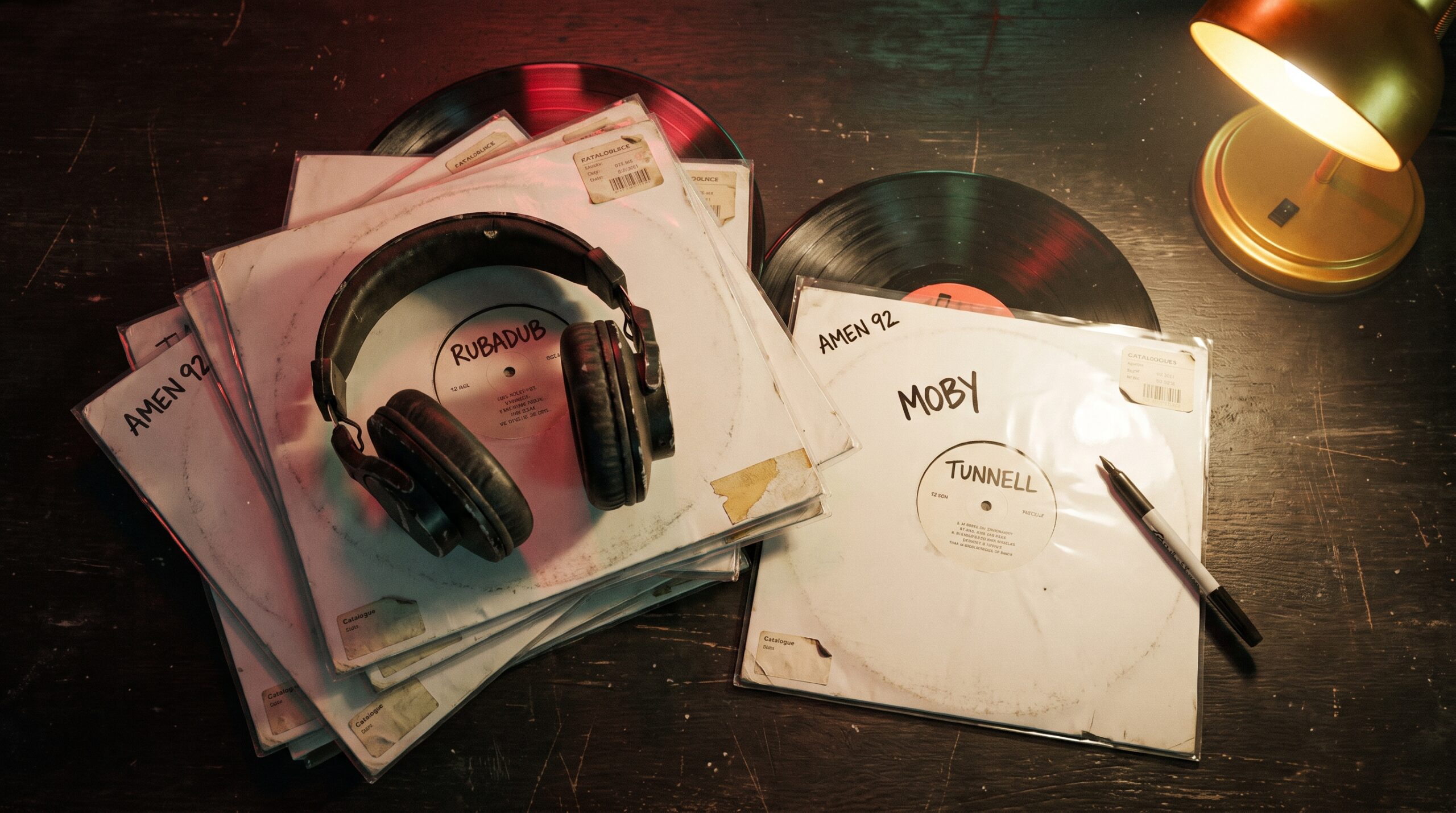

There is a particular kind of excitement that only really happens in a record shop, and a particular kind of object that only really happens in dance music. A blank white label, twelve inches of vinyl, a hole in the middle, and almost no information on it. A catalogue number, sometimes, scribbled in the run-out groove or written in marker pen on the sleeve. A track name, occasionally. The artist name, very often, missing. To the untrained eye, it is just a record. To the people who understood what they were looking at, it was, in a manner of speaking, the most exciting thing in the shop.
The white label is, in dance music, a particular kind of object. It is not, strictly speaking, a genre thing — every dance music scene has had them. But in Jungle, in drum and bass, in the broader UK underground bass-music world, the white label became a kind of cultural shorthand. The white label meant the record was either: a test pressing, a promo, a dubplate, a hand-pressed limited run, an exclusive, or, in some cases, simply a record that the label did not want to put their full artwork on for whatever reason. The information on the record was deliberately limited. The story behind the record was, in a manner of speaking, what you had to find out for yourself.
What a white label actually is
A white label is, in practical terms, a record pressed onto a blank white label instead of the label’s usual printed artwork. The music is the same as the version that will eventually get the proper artwork. The pressing is often done at a smaller plant, sometimes by the label themselves, sometimes by a friend with a lathe, sometimes by a third-party plant that does small runs. The records are usually 12-inch, designed for DJs, and pressed in numbers ranging from a handful (for dubplates) to a few hundred (for test pressings and small-run promos).
White labels exist for a number of reasons. Sometimes a label wants to test a record with DJs before committing to a full pressing. Sometimes an artist wants to put a record out without the baggage of a formal release — a tune they made, pressed up, handed to a few DJs, no label involved. Sometimes the record is being held back for a particular DJ, or for a particular sound system, and the white label is the version that travels among the people who already have it. Sometimes the white label is the only version that ever exists, in which case it is essentially an art object, in a manner of speaking, pressed onto vinyl.
Mystery as part of the discovery
The thing that made a white label exciting was, in a manner of speaking, the not-knowing. You would hear a record on a pirate radio station, or at a rave, or at a friend’s house, and you would go to the record shop and ask the counter person about it, and the conversation would go something like: “It’s a white label.” “Who is it by?” “Can’t say.” “When is it coming out?” “Not sure, mate.” “How much is it?” “Twelve quid.” And you would buy it on the basis of hearing it once, in a manner of speaking, with the understanding that the record might be in your hands for the rest of the night and then disappear, never to be repressed, and that this was a normal state of affairs.
This is a strange experience to describe to anyone who came up after streaming made everything instantly findable. The fact that you did not know what the record was, that you had to find it through the scene, that the person behind the counter had a relationship with the DJ who made it, that the record’s identity was, in a manner of speaking, a private thing that you could be let in on — that was the whole point. The music was not the only thing the white label was selling. It was also selling the experience of being in a community where information was shared because you had earned the right to be told.
And the people who knew the records — the DJs, the counter staff at the specialist record shops, the regulars who came in every Saturday — were, in a manner of speaking, the librarians of the scene. They knew what was on the white labels. They knew which records had been white-labeled by which producers. They knew which records had come out properly under a different name. They were, in a manner of speaking, a human search index, and the information they held was not on the internet because the internet did not have it yet.
DJ culture and the cult of the exclusive
For a DJ, a white label was, and still is, a particular kind of currency. Having a record on a white label that nobody else had access to was, in a manner of speaking, the most valuable thing in your record box. It meant that when you played it at a club night, the crowd was hearing something they could not get. They had to come back the next time you played to hear it again. The white label was, in a sense, a way of building an audience.
Dubplates, in particular, are a specific form of white label. A dubplate is a one-off acetate or test pressing cut specifically for a particular DJ or sound system, often with the DJ’s name or the system’s name written on the label. A dubplate is, in a manner of speaking, the only copy in the world. Playing a dubplate on pirate radio or at a sound-system event was, and is, a particular kind of flex — the record that nobody else can get, played by the person who has it.
The aesthetic of the white label, the blank record with the handwritten title and the catalogue number, was part of this. A white label was, in a manner of speaking, a record that had not yet been finished. It was a record in transit, in a manner of speaking, between the studio and the full release, or between the artist and the public. The blank label signalled that, in a way the artwork on a normal record could not. It was, in a sense, the record equivalent of a working draft.
Trainspotters and the obsession with the unknown
There is a particular kind of music fan, in dance music, called a trainspotter. A trainspotter is somebody who is obsessive about identifying records — particularly white labels and dubplates — that they have heard on pirate radio, in sound-system sets, in clubs, or on tapes. Train-spotters would, in a manner of speaking, keep notebooks of catalogue numbers, write down the timestamps of records on pirate radio shows, take field recordings of sound systems, and collaborate with other train-spotters to identify the records that nobody else could find.
For a long time, the trainspotter community was the closest thing the scene had to a research department. They were the people who figured out which producer was behind a particular white label, which sample was used in a particular record, which pressing plant had cut a particular acetate. The information they generated was, in many cases, eventually made public on internet forums and Discogs pages, but the original work was done by individuals, in person, with notebooks, in record shops. The trainspotter, in a manner of speaking, was the original Jungle archivist.
Train-spotting is, in a sense, still around. It just works differently now. A trainspotter in 2026 is more likely to be figuring out which AI-generated track somebody posted on SoundCloud was built from which Amen break, or which uncredited remix on Bandcamp is the version that was played on a particular pirate radio show in 1994. The methodology is the same. The tools are different.
Why the aesthetic survives
One of the interesting things about contemporary Jungle is how often the white-label aesthetic shows up. Modern producers, releasing records in 2024, 2025, 2026, will frequently put a record out on a white label first, and only later give it the proper artwork. There are labels that release everything on white labels. There are record shops that still do brisk trade in white-label-only catalogues. The aesthetic has not gone out of fashion, in a manner of speaking, because the aesthetic never really was fashion. It was a function — the function of putting out a record before it is ready to be a finished object.
What survives, and what the contemporary scene understands, is that the white label is more than just a marketing decision. It is, in a manner of speaking, a statement about how the record wants to be encountered. A record on a white label wants to be found by the people who will play it loud, on a system, in a room. It does not want to be on a streaming playlist. It does not want to be in a chart. It wants to be in a record-shop crate, or in a DJ’s box, or in a sound system’s collection. The blank label is the visual signal of all of that. The music, of course, is the substance.
For a label or producer working in 2026, putting a record out on white label is, in a manner of speaking, a way of saying: this is the kind of record that is for the people who know. A great many of the most interesting records being made right now are, in fact, going out on white label first, in small runs, to DJs and record shops, before the full release. The pattern is older than most people in the scene, and it still works.
Where to start digging
If you are interested in white-label culture, the easiest place to start is the record shops. Most cities with a dance music scene have at least one specialist shop that stocks white labels, and the people behind the counter are, in a manner of speaking, the entry point. Tell them what you like. They will know what is on the white labels that has not been written about online. They will, in many cases, have records that are not on Discogs, that are not on streaming, that exist only as the physical object in their shop.
If you are not near a specialist shop, the labels are, in a manner of speaking, the next best entry point. There are dozens of small Jungle labels releasing on white label. Our labels archive is a starting point, in a manner of speaking — a list of the labels that have been doing the work, with a sense of which ones are still actively releasing and which are historical. From there, the records, the people, the shops, the nights, the whole thing, in a manner of speaking, follows.
And if you find yourself standing in a record shop, in a manner of speaking, holding a white label in your hand, with no idea what it is, and the person behind the counter is telling you it is the tune that DJ whatever played on pirate radio last weekend — that, in a manner of speaking, is the entire scene in a single moment. The white label is still doing what it has always done. It is, in a manner of speaking, the record equivalent of a rumour. The music is the substance. The mystery is the appeal.
Read next: How Jungle found its own sound. · Or: The Amen Break, six seconds that changed Jungle.
Leave a Reply