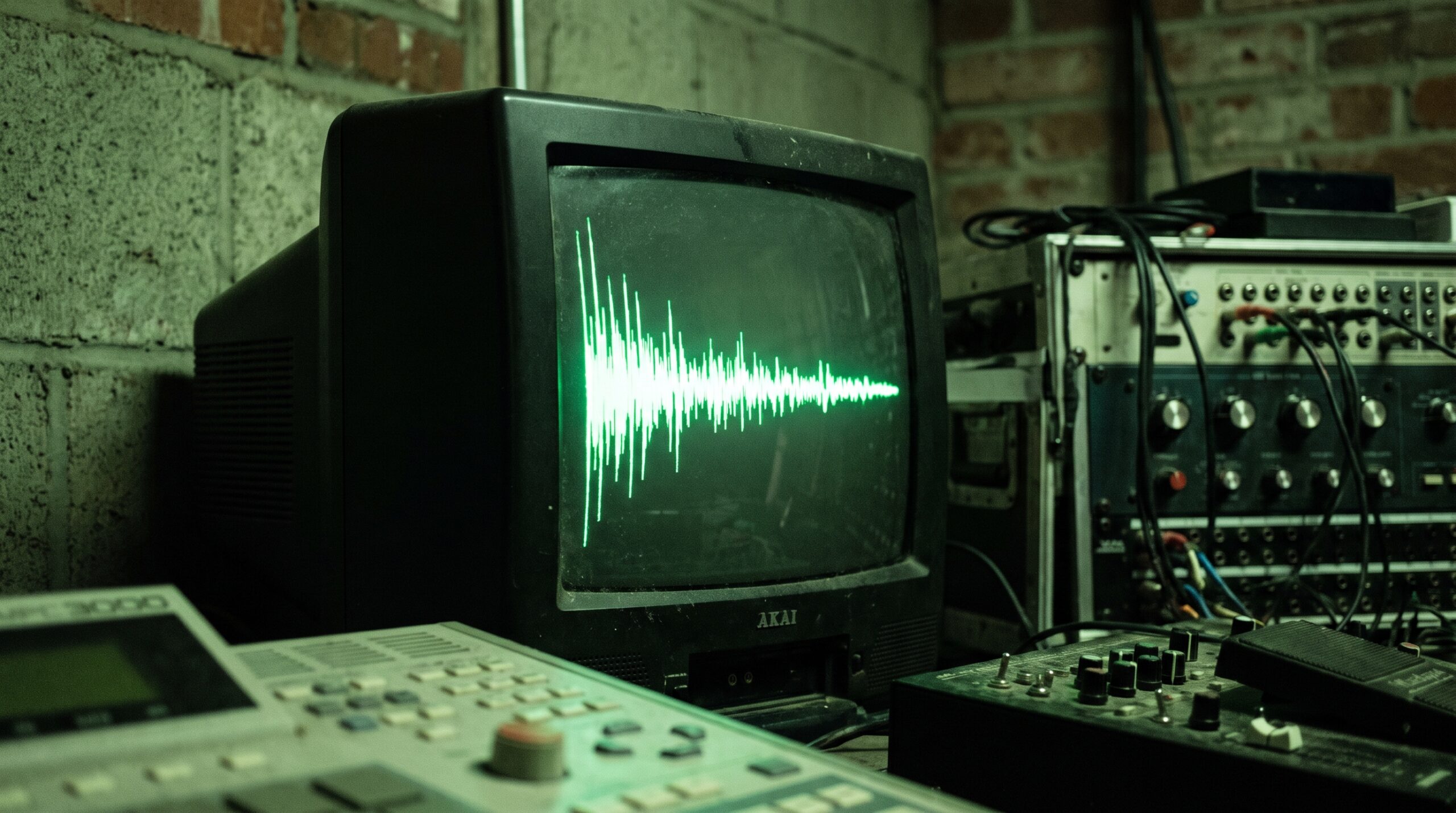
It is six seconds long. It sits in the middle of the B-side of a 1969 soul record. It was played by a drummer named Gregory Coleman. By the late 1980s it had been lifted by hip-hop producers; by the mid-1990s it was being chopped, timestretched, and rearranged on hardcore and jungle records across the UK. It is, by any reasonable measure, the most sampled loop in popular music. It is the Amen Break.
The source
The Winstons were a funk and soul group from Washington, D.C. In 1969 their single “Color Him Father” won the Grammy Award for Best Rhythm and Blues Recording. The B-side was “Amen, Brother.” It was written by Richard L. Spencer and performed by the group’s drummer, Gregory Coleman. About a minute and a half into the track there is a short drum break — four bars of pure rhythm, a syncopated pattern over a swung backbeat. It is the Amen Break.
How it spread
By the mid-1980s, hip-hop producers had begun sampling the break. N.W.A.’s “Straight Outta Compton” (1988) lifted it. It crossed into rave and breakbeat hardcore around 1990 and 1991, accelerated by the London warehouse scene and the pirate radio stations that fed it.
When jungle emerged as a distinct style in 1992 and 1993, the Amen Break was already the most recognisable drum loop in UK underground dance music. Producers chopped it into constituent hits — kick, snare, hat — and reassembled them around new basslines, reggae vocal samples, and time-stretched pads. It is hard to overstate its centrality. To listen to jungle between roughly 1993 and 1996 is, in large part, to listen to the Amen Break in an ever-growing number of costumes.
Why it works
Drum-machine programmers have argued about the Amen Break for decades. The pattern has unusual dynamics: a strong kick, a heavy snare on three, swung hat work, and small ghost notes on the snare that give it a human push. The swing is real — Coleman was a drummer, not a sequencer. It is also short, which makes it easy to loop and rearrange. And it is loud in the mix, with a clear mid-range thump that survives a sampler running at 33 or 45 RPM.
What jungle did with it
Jungle producers took the Amen apart and put it back together. The break was timestretched to fit slower tempos, sliced into percussive hits, layered with ragga vocal stabs, rebuilt around sub-bass and Reese basslines, and run through analogue and digital signal processing. The break stopped being a single pattern and became a vocabulary. To this day a jungle record without at least one element traceable to the Amen is the exception rather than the rule.
Provenance and credit
The Amen Break is a useful case study in the longer history of sampling. The Winstons never received royalties from the break’s use. Gregory Coleman died homeless in 2006. A 2015 project, the Amen Break Scholarship, raised money for his family after his death. The original recording remains under copyright; the break itself is a small, six-second excerpt whose use is, in legal terms, a matter of license and fair use that has rarely favoured the source.
For JungleSound, the Amen Break is also a reminder of what we want this site to be: a place that traces music to its sources, credits the people behind the sounds, and treats the history of the music with the seriousness it deserves.
Leave a Reply